
Florida Car Accident Statistics 2026: Crashes, Injuries and Fatalities
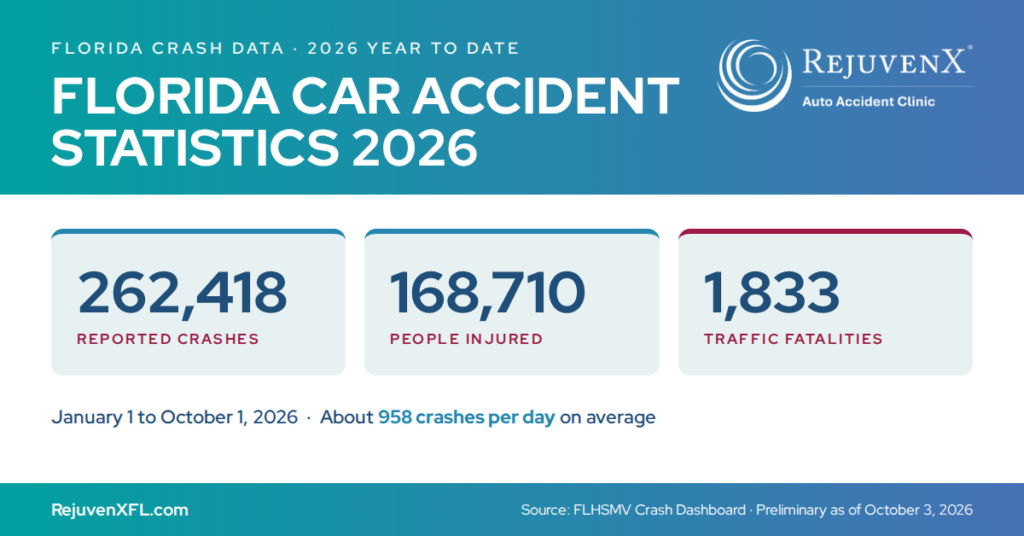
As of October 1, 2026, Florida has recorded 262,418 reported traffic crashes in 2026, with 168,710 people injured and 1,833 fatalities, according to the Florida Department of Highway Safety and Motor Vehicles (FLHSMV) Crash Dashboard. FLHSMV lists these figures as preliminary as of October 3, 2026.
This guide breaks the 2026 totals down by severity and hit-and-run involvement, sets them beside four completed years of statewide history, and adds full-year 2024 county figures for the regions RejuvenX serves. Because late crash reports keep arriving, we update this page every quarter.
Data through: October 1, 2026
Data status: Preliminary year-to-date
Geographic coverage: Florida (statewide)
Primary source: Florida Department of Highway Safety and Motor Vehicles (FLHSMV) Crash Dashboard
Some sections use other datasets with their own periods: full-year 2024 FLHSMV Traffic Crash Facts for county figures, and Signal4 Analytics for monthly and weekday severe outcomes (January 1-July 3, 2026). Each table names its source and period.
Key Takeaways
Key Takeaways
- Florida recorded 262,418 reported traffic crashes from January 1 through October 1, 2026, an average of about 958 crashes per day (FLHSMV, preliminary as of October 3, 2026).
- Those crashes injured 168,710 people and killed 1,833 people over the same period.
- In completed-year FLHSMV data, statewide crashes fell 7.52% from 2022 (397,620) to 2025 (367,717), while fatalities fell 15.71%, from 3,553 to 2,995. The 2025 figures are preliminary.
- The 2026 totals are preliminary year-to-date counts and can change as late reports arrive, so this page does not compare them with 2025 until a matched period is available.
Florida Car Accident Statistics at a Glance
Florida recorded 262,418 reported traffic crashes from January 1 through October 1, 2026. Of those, 112,696 were injury crashes and 1,702 were fatal crashes. Across all crashes, 168,710 people were injured and 1,833 people died, according to preliminary FLHSMV Crash Dashboard data as of October 3, 2026.
STAT CARDS MODULE (January 1-October 1, 2026, FLHSMV Crash Dashboard, preliminary):
- 262,418 reported crashes
- 112,696 injury crashes
- 168,710 people injured
- 1,702 fatal crashes
- 1,833 traffic fatalities
- 9,622 pedestrian crashes
- 6,261 bicycle crashes
- 5,999 motorcycle crashes
- 66,633 hit-and-run crashes
Source: FLHSMV Crash Dashboard, statewide, January 1-October 1, 2026. Preliminary as of October 3, 2026.
| Metric | January 1-October 1, 2026 |
|---|---|
| Reported crashes | 262,418 |
| Injury crashes | 112,696 |
| People injured | 168,710 |
| Fatal crashes | 1,702 |
| Traffic fatalities | 1,833 |
About 43.59% of reported crashes this year were classified as injury or fatal crashes ((112,696 + 1,702) / 262,418). Spread across the 274 calendar days from January 1 through October 1, Florida averaged about 958 reported crashes per day. That daily figure is an average of what has been reported, not a forecast.
How Florida Crash Totals Compare With Previous Years
Florida’s reported crash totals declined in each completed year from 2022 through 2025, according to FLHSMV full-year data. Crashes fell from 397,620 in 2022 to 367,717 in 2025, and traffic fatalities fell from 3,553 to 2,995. The 2025 figures remain preliminary as of October 3, 2026, and 2026 is still a partial year.
| Year | Period | Crashes | People injured | Fatalities | Data status |
|---|---|---|---|---|---|
| 2022 | January 1-December 31 | 397,620 | 252,169 | 3,553 | Finalized as of January 22, 2024 |
| 2023 | January 1-December 31 | 395,175 | 252,285 | 3,375 | Finalized as of January 8, 2025 |
| 2024 | January 1-December 31 | 381,423 | 246,426 | 3,098 | Finalized |
| 2025 | January 1-December 31 | 367,717 | 238,959 | 2,995 | Preliminary as of October 3, 2026 |
| 2026 (partial) | January 1-October 1 | 262,418 | 168,710 | 1,833 | Preliminary as of October 3, 2026 |
Source: FLHSMV Crash Dashboard, statewide, full calendar years 2022-2025 and partial 2026. The 2026 row is a partial year and is not comparable with the full-year rows.
When Florida Crashes Happen
In Signal4 Analytics data for January 1 through July 3, 2026, Florida’s monthly traffic fatalities peaked in February (265) and serious injuries peaked in April (1,042). By day of the week, Saturday recorded the most fatalities (224) and Friday the most serious injuries (940). These figures count severe outcomes, not all crashes.
The tables below show when fatalities and serious injuries were recorded, not when crashes of all kinds happen most often. They come from a different source and period than the FLHSMV totals above, so the two should not be combined. Signal4 last updated this data September 4, 2026.
By month
| Month, 2026 | Fatalities | Serious injuries |
|---|---|---|
| January | 194 | 907 |
| February | 265 | 987 |
| March | 245 | 1,036 |
| April | 205 | 1,042 |
| May | 218 | 1,019 |
| June | 168 | 772 |
Source: Signal4 Analytics, Florida Traffic Safety Report, page 1, January 1-July 3, 2026; data last updated September 4, 2026. July is a partial month and is excluded.
February recorded the highest monthly fatality count of the six completed months, even though it is the shortest month. Serious injuries ranged from 907 to 1,042 per month from January through May. June shows the lowest counts in both columns; because it is the most recent completed month in a report updated September 4, it is also the month most likely to change as late reports are added.
By day of the week
| Day of week | Fatalities | Serious injuries |
|---|---|---|
| Monday | 175 | 782 |
| Tuesday | 128 | 735 |
| Wednesday | 164 | 833 |
| Thursday | 178 | 825 |
| Friday | 208 | 940 |
| Saturday | 224 | 859 |
| Sunday | 218 | 808 |
Source: Signal4 Analytics, Florida Traffic Safety Report, page 2, January 1-July 3, 2026; data last updated September 4, 2026.
Friday, Saturday, and Sunday together accounted for 650 of the 1,295 fatalities in this table (about 50.19%) and 2,607 of the 5,782 serious injuries (about 45.09%). Tuesday recorded the fewest of both. Because severe outcomes cluster toward the end of the week, it helps to know where care is available outside standard weekday hours; our guide to weekend car accident care covers what to do if a crash happens on a Saturday or Sunday.
Florida Hit-and-Run Crash Statistics
FLHSMV recorded 66,633 hit-and-run crashes in Florida from January 1 through October 1, 2026, about 25.39% of all reported crashes. Those crashes injured 12,810 people and killed 139 people, according to preliminary Crash Dashboard data as of October 3, 2026. A matched 2025 period isn’t available, so this page shows no hit-and-run trend.
| Hit-and-run measure | January 1-October 1, 2026 |
|---|---|
| Hit-and-run crashes | 66,633 |
| People injured | 12,810 |
| Fatalities | 139 |
| Share of all reported crashes | 25.39% |
Source: FLHSMV Crash Dashboard, statewide, January 1-October 1, 2026, preliminary as of October 3, 2026. Share calculated against 262,418 total reported crashes.
A hit-and-run classification means a driver involved in the crash left the scene. It is a reporting category, not a finding about who was responsible for the crash. Florida’s Personal Injury Protection (PIP) is no-fault coverage, so it is designed to apply to your own injuries regardless of who caused the crash, subject to your policy; our guide explains how PIP and EMC work in Florida.
County Crash Statistics Where We Treat Patients
In full-year 2024 FLHSMV Traffic Crash Facts data, Palm Beach County recorded 26,550 crashes and Hillsborough County 26,269, the highest totals among the counties we serve. Lee County recorded 14,737 crashes, Sarasota 6,952, Manatee 6,469, and Collier 6,260. These are 2024 county totals, not city or 2026 figures.
| County | RejuvenX clinics | Crashes | People injured | Fatalities | Reporting period |
|---|---|---|---|---|---|
| Hillsborough | Tampa, Brandon | 26,269 | 17,359 | 180 | January 1-December 31, 2024 |
| Sarasota | Sarasota, Venice | 6,952 | 4,255 | 55 | January 1-December 31, 2024 |
| Manatee | Bradenton | 6,469 | 4,547 | 61 | January 1-December 31, 2024 |
| Lee | Fort Myers | 14,737 | 9,035 | 123 | January 1-December 31, 2024 |
| Collier | Naples | 6,260 | 3,609 | 59 | January 1-December 31, 2024 |
| Palm Beach | West Palm Beach, Royal Palm Beach, Boynton Beach | 26,550 | 16,564 | 207 | January 1-December 31, 2024 |
| Pinellas | St. Petersburg, Clearwater | 14,391 | 8,804 | 108 | January 1-December 31, 2024 |
| Charlotte | Port Charlotte | 2,862 | 1,628 | 29 | January 1-December 31, 2024 |
Source: FLHSMV 2024 Traffic Crash Facts, printed pages 55-60, January 1-December 31, 2024. Report closeout January 22, 2026; FLHSMV notes the figures remain subject to change. County totals only; these are not city totals and are not 2026 figures.
The rows cover selected counties where RejuvenX operates, not a statewide county ranking, and they should not be compared with the 2026 statewide totals above.
Tampa and Hillsborough County
Hillsborough County recorded 26,269 crashes, 17,359 people injured, and 180 fatalities in 2024. RejuvenX provides car accident care in Tampa and car accident care in Brandon. For a closer look, see our Tampa and Hillsborough County car accident statistics.
Sarasota and Bradenton
Sarasota County recorded 6,952 crashes and 55 fatalities in 2024, and Manatee County recorded 6,469 crashes and 61 fatalities. RejuvenX clinics in Sarasota, Venice, and Bradenton serve the two counties. Our Sarasota and Bradenton car accident statistics guide covers both.
Fort Myers and Naples
Lee County recorded 14,737 crashes and 123 fatalities in 2024, and Collier County recorded 6,260 crashes and 59 fatalities. RejuvenX provides car accident care in Fort Myers and car accident care in Naples. See our Fort Myers and Naples car accident statistics for the county detail.
Palm Beach County
Palm Beach County recorded 26,550 crashes, 16,564 people injured, and 207 fatalities in 2024, the highest crash and fatality totals among the counties in this table. RejuvenX clinics in West Palm Beach, Royal Palm Beach, and Boynton Beach serve the county. Read our Palm Beach County car accident statistics for more.
In Pinellas County, RejuvenX provides car accident care in St. Petersburg and car accident care in Clearwater, which opened October 1, 2026. In Charlotte County, see car accident care in Port Charlotte.
Been in a crash in one of these counties? RejuvenX has clinics across the Tampa Bay area, Southwest Florida, and Palm Beach County.
What Crash Statistics Mean for Accident Injury Care
Statewide crash statistics describe patterns across Florida’s roads; they cannot tell you whether you were injured or how. Injuries can occur even in crashes that seem minor, and symptoms may appear right away or develop over the following days. A clinical evaluation is how a provider assesses and documents your condition.
A post-accident evaluation may include a review of how the crash happened, a physical and neurological exam, and range-of-motion testing. Providers use those findings, along with your symptoms and history, to decide whether imaging, rehabilitation, or other care is appropriate for you. Common concerns after a collision include whiplash, neck pain, back pain, and soft tissue injuries, each of which can be evaluated clinically.
Depending on your evaluation, care at RejuvenX may involve:
- Chiropractic care after a car accident, available at every RejuvenX clinic, provided by state-licensed chiropractors.
- Therapeutic rehabilitation, including physiotherapy to help restore movement and strength, available at every clinic.
- Diagnostic imaging when clinically indicated. On-site X-ray is available at every clinic, and MRI is available at Royal Palm Beach.
- Car accident pain management when clinically indicated, available at Sarasota, Naples, and West Palm Beach.
RejuvenX is not an emergency facility. If you or someone else has a medical emergency, call 911 or go to the nearest emergency room.
You can also browse all RejuvenX locations.
Medical Documentation and Coordinated Care After an Accident
After a crash, medical documentation records what your providers found and recommended: examination findings, imaging reports when imaging is performed, treatment recommendations, and progress notes. RejuvenX provides medical records and bills within 24-48 hours of an authorized request, which helps keep patients, care teams, and legal teams working from the same information.
For patients, consistent documentation means each provider on your care team can see what was found at your first visit and how your condition has changed since. Your chiropractor, rehabilitation team, and, where applicable, imaging and pain management providers share notes so your care plan reflects your current findings rather than a single snapshot.
For attorneys and case managers working with our patients, documentation is how you stay informed about a client’s care. With the patient’s authorization, RejuvenX provides:
- Examination findings and treatment recommendations
- Imaging reports, when imaging is performed
- Progress notes across the course of care
- Medical records and bills within 24-48 hours of an authorized request
When clinically appropriate, emergency medical condition (EMC) determinations at RejuvenX are made by qualified providers. An evaluation does not guarantee any particular determination; the provider bases any EMC finding on the patient’s clinical presentation.
Working with RejuvenX
If you have a client in need of treatment, our Care Partners page explains how your patient or client can request an appointment, as well as how we handle records requests and communication with our care team. You can learn more there. RejuvenX does not provide legal or insurance advice and does not predict the outcome of any claim.
Florida PIP and the 14-Day Requirement
Florida Statutes section 627.736 ties Personal Injury Protection (PIP) medical benefits to initial services and care received within 14 days after a motor vehicle accident, subject to statutory conditions. Coverage and eligibility depend on the individual policy and circumstances.
The 14-day window is an insurance eligibility rule. Whether and when you need care is a separate, medical question, and you shouldn’t use the PIP deadline to decide how urgent your symptoms are. If you have a medical emergency, call 911. For a fuller explanation of PIP and emergency medical condition determinations, see how PIP and EMC work in Florida. For questions about imaging costs, read who pays for X-rays and medical bills after a Florida crash.
Frequently Asked Questions
The answers below use the same sources and periods as the rest of this page: FLHSMV Crash Dashboard data for January 1-October 1, 2026 (preliminary as of October 3, 2026), and Signal4 Analytics data for January 1-July 3, 2026.
Florida recorded 262,418 reported traffic crashes from January 1 through October 1, 2026, according to the FLHSMV Crash Dashboard. Of those, 112,696 were injury crashes and 1,702 were fatal crashes. FLHSMV lists these statewide figures as preliminary as of October 3, 2026, and the totals may rise as late crash reports are added.
From January 1 through October 1, 2026, Florida averaged about 958 reported traffic crashes per day. That figure divides the 262,418 crashes FLHSMV recorded statewide by the 274 calendar days in the period. It is an average of reported crashes, not a forecast, and the underlying total is preliminary as of October 3, 2026.
FLHSMV recorded 1,833 traffic fatalities in Florida from January 1 through October 1, 2026, in 1,702 fatal crashes. The same preliminary Crash Dashboard data, as of October 3, 2026, shows 168,710 people injured statewide. One fatal crash can involve more than one death, which is why fatalities exceed fatal crashes.
policy details and explain how billing works before treatment begins.
Florida Statutes section 627.736 ties Personal Injury Protection (PIP) medical benefits to initial services and care received within 14 days after a motor vehicle accident, subject to statutory conditions. Coverage and eligibility depend on the individual policy and circumstances. The 14-day window is an insurance rule; whether you need care is a separate medical question.
In Signal4 Analytics data for Florida from January 1 through July 3, 2026, fatalities peaked in February (265) and serious injuries in April (1,042) among completed months. Saturday recorded the most fatalities (224) and Friday the most serious injuries (940). These figures count severe outcomes only, not all crashes, and were last updated September 4, 2026.
RejuvenX updates this Florida statistics page every quarter. FLHSMV’s Crash Dashboard totals change as late reports arrive, so each update records the data cutoff and status date. Full-year 2026 figures are planned for early 2027, labeled preliminary until FLHSMV confirms final numbers. The current version uses data through October 1, 2026.
Sources and Methodology
This page covers reported traffic crashes in Florida statewide, using official state data and one university-maintained crash database. Every table names its source and period. The headline 2026 figures cover January 1-October 1, 2026, were preliminary as of October 3, 2026, and were reviewed on October 8, 2026.
Sources used
- FLHSMV Crash Dashboard: 2026 totals, hit-and-run figures, and 2022-2025 statewide history.
- FLHSMV Traffic Crash Reports and Statistics, 2024 Traffic Crash Facts: county figures (pages 55-60). Closeout January 22, 2026; figures remain subject to change.
- Signal4 Analytics (University of Florida), Florida Traffic Safety Report: monthly and weekday fatalities and serious injuries only, January 1-July 3, 2026, updated September 4, 2026.
- FDOT Crash Data Systems and Mapping: how Florida’s crash data systems differ in coverage and timeliness.
- Florida Statutes section 627.736: the PIP 14-day initial-care requirement.
How we compare and calculate
- We compare full years only with full years. The 2026 figures are year-to-date, and this page does not compare them with 2025 because a matched January 1-October 1, 2025 range is not part of this dataset.
- Percent change = (current year minus previous year) / previous year × 100.
- The daily average divides total reported crashes by the 274 inclusive calendar days from January 1 through October 1, 2026.
- Category shares use statewide totals from the same source and period. Overlapping categories are never added together.
- Each table uses one source, because sources differ in extraction dates and counting rules.
Why the numbers can differ
Dashboard totals change as late reports arrive, sometimes for months after a year ends, while annual reports close out on a fixed date. A full-year figure in Traffic Crash Facts can therefore differ from the dashboard figure for the same year, and some annual-report subtables count one record per driver rather than per crash.
Definitions
- Crash: a reported traffic crash recorded in Florida’s crash reporting system.
- Injury crash: a crash in which at least one person was reported injured.
- Fatality: a death resulting from a reported traffic crash, as counted by FLHSMV.
- Serious injury: an injury classified as serious in the Signal4 dataset; used on this page only for the Signal4 monthly and weekday tables.
- Hit-and-run: a crash in which a driver involved left the scene.
RejuvenX is a car accident injury clinic offering care by state-licensed chiropractors and additional rehabilitation services by licensed professionals. RejuvenX does not promise or predict recovery timelines or compensation outcomes.